“The dog needs someone to feed it, and the plants need watering every day.”
My mother announced the decision as casually as if she were talking about the weather instead of canceling the only weekend I had been looking forward to in months. Her suitcase was already waiting beside the front door, my father kept glancing at his watch, and my older sister, Vanessa, barely looked up from her phone.
“Why me,” I asked, “when the whole family is going on vacation?”
Vanessa finally raised her eyes long enough to give me a smug smile.
“That’s your role in this house.”
I waited for my parents to correct her or tell her she had crossed a line, but neither of them said a single word. Their silence made it painfully clear that they agreed with everything she had just said.
At twenty-four, I worked full-time, paid my own bills, contributed to groceries, and covered plenty of household expenses. Even so, my family still treated me like someone whose only purpose was making everyone else’s lives easier.
Instead of arguing, I quietly went upstairs and packed two changes of clothes, my laptop, important documents, and the emergency cash I kept hidden inside an old poetry collection. While everyone loaded luggage into the car, I slipped out through the back door, ordered a rideshare, and headed to my friend Hannah’s apartment across town.
Hours passed before anyone realized I wasn’t at the house. At exactly 7:42 that evening, my phone lit up with a stream of messages.
Mom: Where are you?
Dad: This is childish.
Vanessa: You better be home when we get back.
I turned my phone face down and ignored every notification. For the first time in years, I slept through an entire night without expecting someone downstairs to shout my name because they wanted another favor.
The following morning, an unfamiliar number interrupted breakfast. The caller introduced himself in a calm, professional voice.
“Good morning, ma’am. I’m Officer Daniel Ruiz with the Westbrook Police Department. Are you Emily Carter?”
A wave of uneasiness settled over me.
“Yes.”
Officer Ruiz continued without hesitation.
“I’m calling about your parents’ residence on Hawthorne Lane. Someone has reported a break-in.”
I immediately sat upright in my chair.
“A break-in?”
“Yes, ma’am. A neighbor called after seeing the front door open. We found signs of forced entry. We also found a dog inside, alive but distressed. No people were present.”
I glanced toward Hannah before answering.
“My family is away.”
“That’s what we’re trying to confirm. Are you able to come to the property?”
I almost declined, but his tone suddenly became much more serious before I could respond.
“There’s something else. The house wasn’t just burglarized. It appears someone had been watching it. We found several notes inside, and one of them mentioned your name.”
For several seconds, I couldn’t say anything.
“My name?”
Hannah immediately stopped what she was doing and looked at me. I switched the call to speaker before asking the question that neither of us wanted answered.
“What did the note say?”
Officer Ruiz paused only briefly.
“It said, ‘Emily was supposed to be here.’”
Hannah drove me back to Hawthorne Lane, and neither of us spoke much during the trip. I kept looking out the window, trying to convince myself there had to be a simple explanation, but the closer we came to the neighborhood, the more uneasy I became.
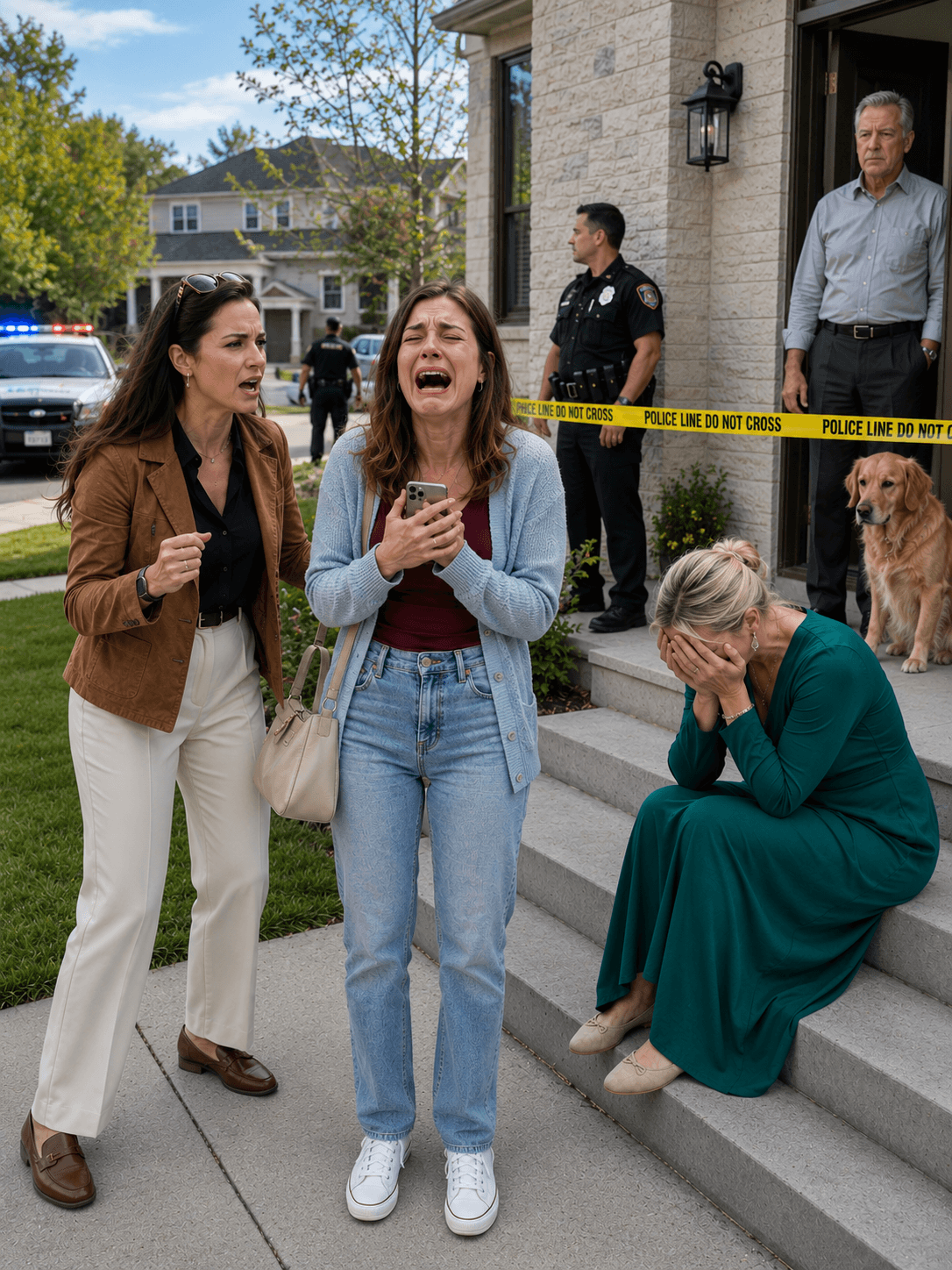
Everything outside looked perfectly ordinary. The lawns were neatly trimmed, sprinklers swept across the grass, and American flags still hung from front porches, yet the yellow police tape stretched across my parents’ front door immediately told a different story. Officer Daniel Ruiz met us near the driveway and led us toward the house.
“Emily Carter?”
“Yes.”
“Thank you for coming. Have your parents been contacted?”
“I’ve tried calling them,” I replied. “They’re driving back from Chicago, but they haven’t answered since last night.”
“The only person who picked up was Vanessa,” I continued. “She just asked, ‘What did you do?’ before hanging up.”
Walking through the front door felt strangely unsettling because the house no longer resembled the place I had left behind. Drawers had been emptied onto the floor, couch cushions had been sliced open, broken dishes covered the hardwood, and every family photograph lining the staircase had been turned around so none of the smiling faces looked into the room anymore.
Buster, our aging golden retriever, was lying quietly in the laundry room beside a bowl of water. The moment he saw me, his tail wagged weakly against the floor, and I knelt beside him, wrapping my arms around his neck before whispering softly,
“Hey, boy. I’m sorry.”
After giving me a moment with the dog, Officer Ruiz asked another question.
“Do you know anyone who expected you to be here this weekend?”
“My family,” I answered bitterly.
“Anyone else?”
I searched through every possibility I could think of, including coworkers, neighbors, classmates, and distant relatives, but none of them made sense.
“No.”
Officer Ruiz guided me into the dining room, where a single sheet of paper had been placed neatly in the center of the table. Written across it in thick black marker were two short messages that immediately made my stomach tighten.
“Emily was supposed to be here.”
Beneath those words was a second sentence.
“Ask Richard why.”