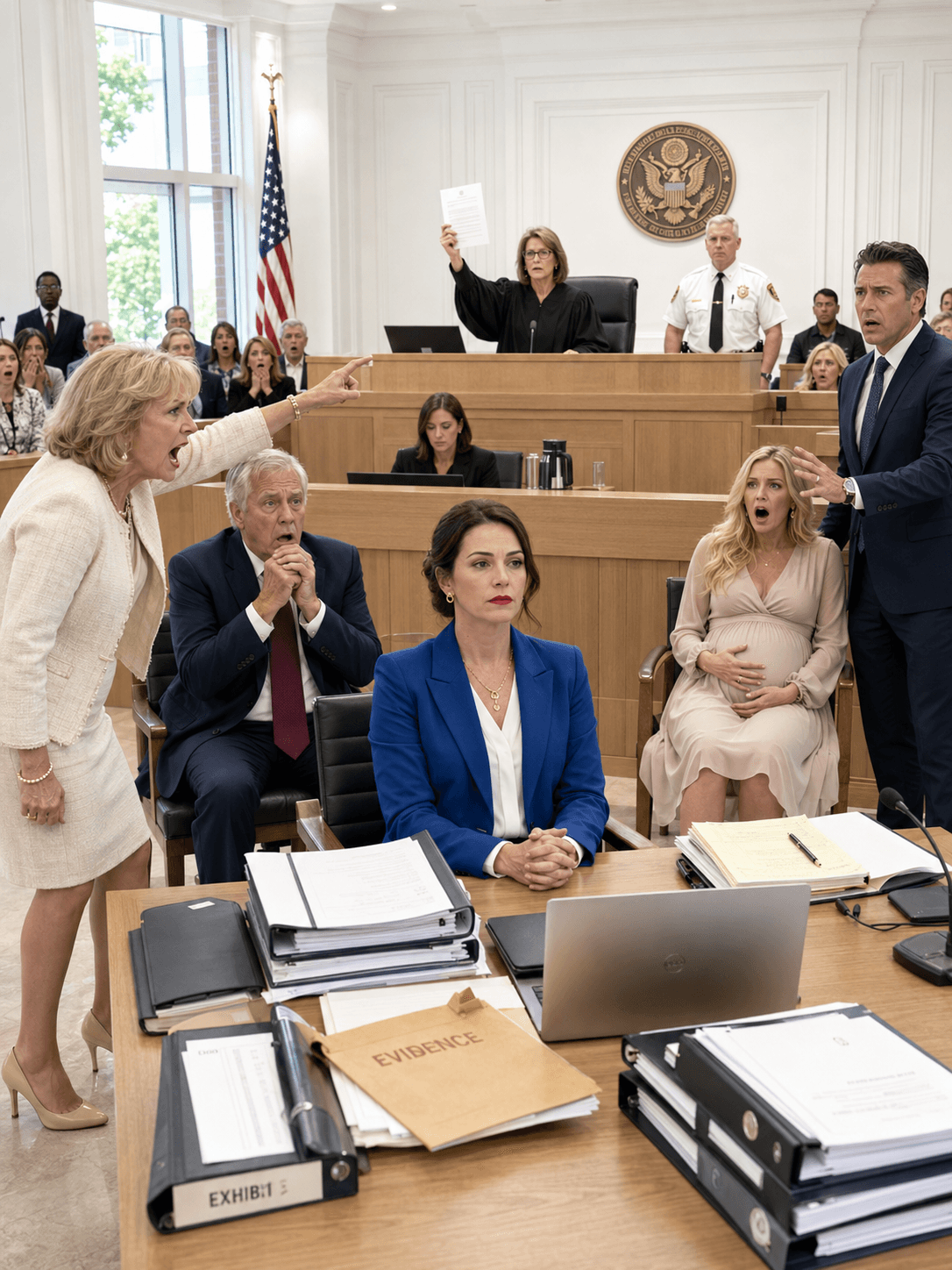
My mother stood in the middle of the courtroom and shouted, “She is a drug addict.” Her accusation sliced through the room, instantly drawing every eye toward me. My younger sister gasped as though the scene had caught her by surprise, while my father remained stiff beside them, gripping his hands together so tightly that his knuckles had turned white.
I stayed seated at the respondent’s table without showing any emotion. I didn’t argue, cry, or interrupt to defend myself. Wearing a charcoal blazer with a dried coffee stain on one sleeve, I simply folded my hands together and waited for the judge to speak.
Judge Elena Ramirez slowly lowered the toxicology report my parents’ attorney had just submitted before looking over her glasses at my mother. “Mrs. Reynolds,” she asked calmly, “are you sure you know what your daughter does for a living?” My mother’s expression immediately changed, her attorney froze in place, and my father’s face lost every trace of color. At that moment, I knew the version of me my family had spent decades inventing was finally beginning to unravel in front of everyone.
My name is Audrey Reynolds, and I am thirty-three years old. For as long as I could remember, my family needed me to be the disappointment of the household because that role made their own lives easier. They convinced themselves I was a failure, and eventually they convinced almost everyone else too.
My parents, Patricia and Richard Reynolds, lived in one of Boston’s wealthy suburbs where reputation mattered more than honesty. My father owned a successful investment advisory firm and never missed an opportunity to exaggerate its importance, while my mother dedicated nearly all her time to charity events, country club committees, fundraising galas, and maintaining the perfect social image.
Although I was their oldest child, I was never the daughter they proudly showed off. That honor always belonged to my younger sister, Melanie. She learned early how to charm adults, shed tears at the perfect moment, and make everyone feel obligated to rescue her whenever she faced consequences.
I was nothing like Melanie. I preferred observing instead of performing, speaking only when I had something meaningful to say, and I had little interest in begging anyone for approval. In my parents’ eyes, those qualities made me cold, difficult, and impossible to love the way they loved my sister.
By the time I turned twelve, the roles inside our family had become permanent. Whenever Melanie made a mistake, everyone blamed stress or bad luck. Whenever I made one, it was treated as proof that something was fundamentally wrong with me. Melanie’s tears were accepted as evidence she had been hurt, while my silence was interpreted as evidence I lacked compassion.
Only one person ever recognized how unfair those rules were. My grandfather Thomas, my mother’s father, had spent his career as a chemistry professor and possessed the rare ability to see people for who they truly were instead of who others claimed they were. While my parents dismissed my science projects as strange hobbies, he would sit beside me, ask thoughtful questions, and encourage every experiment I wanted to try.
When I was fourteen, I built a crude laboratory at home to test soil contamination in neighborhood gardens. Instead of laughing, my grandfather handed me an old microscope and smiled. “If the world under glass interests you more than the world at cocktail parties, you may yet survive this family.”
That single conversation shaped the way I viewed my future. My grandfather taught me that facts could become a shield when people chose lies over truth, and I carried that lesson with me long after childhood ended.
When he passed away years later, he left me a trust worth five million dollars. My parents believed that inheritance was the greatest gift he had ever given me, but they had no idea the money represented only a tiny fraction of everything I had already built on my own.
The trap was set on Thanksgiving evening. I almost turned my car around before reaching my parents’ estate because every visit reminded me that the beautiful house concealed years of manipulation behind its polished walls. Even so, I forced myself to go inside, knowing I couldn’t avoid them forever.
My mother greeted me with a pair of air kisses and an irritated smile. “You’re late,” Patricia said.
“I’m on time.”
“Your sister has been here for an hour.”
“Good for Melanie.”
Her expression tightened, and without another word she led me toward the formal dining room.
The table looked exactly as it did every holiday, covered with expensive crystal, polished silverware, candles, and enough food to impress anyone from the outside. Melanie sat beside her husband, Jamal Pierce, resting one hand on her barely noticeable baby bump, while Jamal wore an expensive navy suit, a gold Rolex, and the smug confidence of someone who mistook borrowed status for genuine success.
I had barely taken my seat when my mother stood up from hers. Instead of making a toast or saying grace, she walked straight toward me and slammed a thick stack of legal documents onto my dinner plate with enough force to crack the china. Gravy splashed across the papers, and mashed potatoes stained my blouse as everyone silently watched.
I looked down at the documents before meeting my mother’s eyes. “Sign it,” Patricia commanded. “Right now.”
The title on the first page immediately caught my attention.
Petition for Permanent Conservatorship.
I read it twice before looking back at her. “What exactly is this?”
My mother’s patience disappeared instantly. “Do not play stupid with me. You are a thirty-three-year-old dropout working some pathetic minimum-wage job at a rundown clinic. You have no assets, no career, no stability, and no ability to manage your own life. Your grandfather’s trust is about to release five million dollars, and we will not let a drug addict squander it.”
My father calmly continued cutting his turkey as though stripping me of my legal rights were an ordinary family discussion. “Listen to your mother,” Richard said. “You’ve been a burden long enough. We filed the paperwork with the court. The judge will grant us control over your finances and medical decisions. It’s for your own good.”
I repeated his words quietly. “For my own good.”
Melanie leaned forward with carefully rehearsed concern. “Audrey, please don’t make this ugly. Mom and Dad are trying to save your life.”
I looked from one face to another, studying my mother’s anger, my father’s entitlement, Melanie’s fake tears, and the greed barely hidden behind Jamal’s confident smile. Within seconds, the entire scheme became obvious. They didn’t want to rescue me. They wanted legal control over my grandfather’s trust so they could declare me incompetent, seize the money, and convince everyone they were acting out of love.
The realization wasn’t shocking. What disappointed me most was how convinced they were that I would simply surrender.
My mother pushed an expensive gold fountain pen toward me. “Sign the waiver of rights.”
I picked up the pen and watched triumph spread across her face because she believed she had already won. A second later, I snapped the pen cleanly in half, sending black ink across every page of the conservatorship petition.
“I would rather burn the money,” I said, “than give you one cent.”
Silence filled the dining room before Melanie suddenly jumped to her feet, knocking over her wineglass. “You are psychotic,” she screamed. “You always ruin everything. Mom and Dad are trying to save you, and you act like you’re better than us.”
I stood slowly and looked directly at my sister. “Let’s get the history straight, Melanie.”
She stopped talking as I continued. “I did not drop out of college because I couldn’t handle pressure. I left because Mom and Dad drained my tuition trust to buy you a Porsche for your eighteenth birthday.”
My mother immediately protested. “That is a lie.”